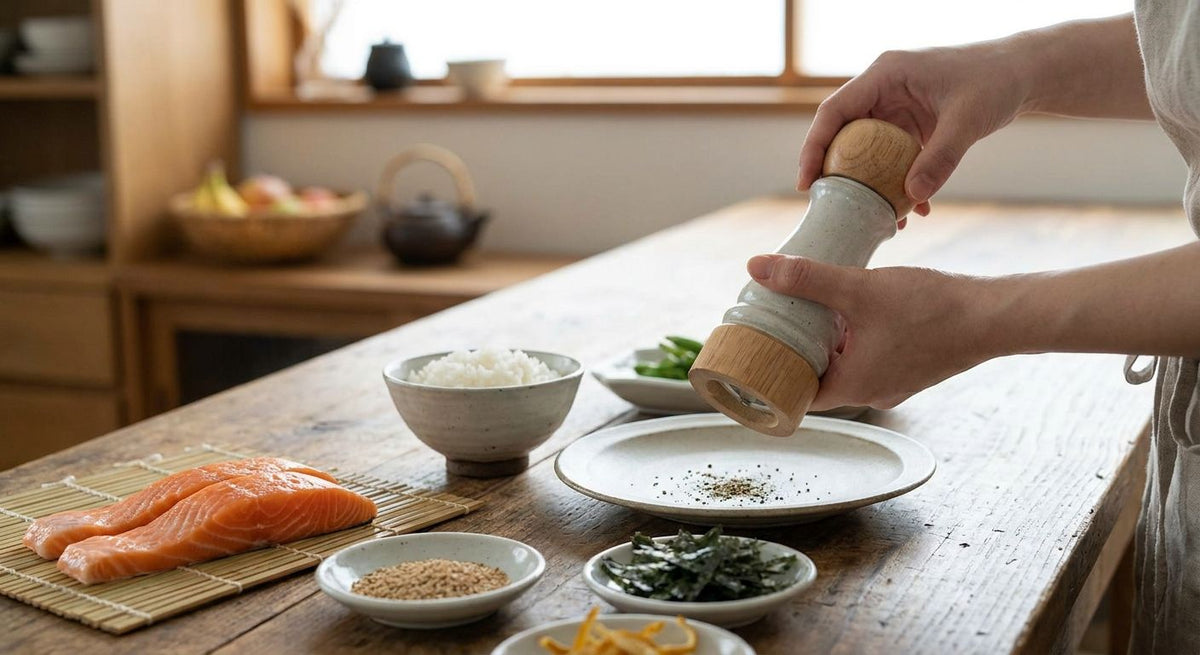


A pepper mill for food trucks and pop-up kitchens is a compact peppercorn grinder built to survive greasy counters, packed lunch rushes, and a service window measured in minutes, not a slow Sunday dinner at home. Food trucks need a mill that grinds fast with one hand, refills without a screwdriver, and keeps working after 200 orders in 90-degree heat with the fryer running six inches away.
- The best pepper mill for food trucks is a manual mill built for one-handed grinding under counter pressure, not an electric unit that dies on battery power.
- Peppermate's Traditional Pepper Mill line holds up to grease and vibration better than shaker-style pepper because the grind mechanism stays sealed.
- Disposable grinders work for one-off pop-ups and festivals; refillable mills win for trucks running the same route every week in 2026.
- Replacement parts matter more on a truck than at home — a cracked top or worn tray shouldn't retire the whole mill.
- Wholesale pricing exists for operators outfitting more than one truck or stall, which matters once a menu scales past a single unit.
Why pepper mill choice matters for food trucks
A home cook grinds pepper over a stove three times a day. A food truck cook grinds it over 150-300 plates during a single lunch service, often standing, often one-handed, often with a line out the window. The mill has to survive that pace without clogging, without an outlet, and without slowing down the person plating the next order.
Health inspectors also treat visible fresh grinding differently than pre-ground shaker dust sitting open on a counter — a sealed mill keeps peppercorns contained until the moment they're ground, which matters on a truck with limited counter space and no walk-in for storage. Pop-up kitchens face the same pressure in a tighter footprint: a folding table, a propane burner, and zero room for a bulky electric grinder that needs a charging dock.
Choose a mill built for one-handed, high-volume grinding
Most home pepper mills are designed for a seated table, twisted slowly between courses. A food truck needs the opposite: fast, repeatable grinds with one hand while the other plates food.
- Pick a mill with a side-crank or top-twist action that works while gripping a plate or tongs.
- Test the grind pressure needed — a mill that requires two hands to turn will slow every ticket.
- Confirm the hopper holds enough peppercorns for a full shift without a mid-rush refill.
- Look for a sealed grind chamber that keeps oil and grease from the flat-top off the mechanism.
The PepperMate Traditional Pepper Mill uses a bottom-crank design built for single-hand operation, which is the main reason it shows up on more than one food truck counter compared to twist-top mills that need both hands.
Stock replacement parts before you're stuck at a festival
A mill that grinds 300 times a day wears differently than one used twice a week at home. The part that fails first on a truck is almost never the whole unit — it's a cracked top or a worn tray.
- Keep a spare grind top on the truck, not back at the commissary kitchen.
- Replace the catch tray if it's cracked or no longer seats flush — a loose tray spills ground pepper onto the counter.
- Check crank tension monthly; a loose crank on a high-use mill grinds unevenly by week three.
- Skip full mill replacement when a single part failure is the actual problem.
Match grind consistency to your menu
Tacos, burgers, and BBQ plates each want a different pepper texture, and a truck menu usually covers more than one of those in the same service.
- Coarse grind for steak, brisket, and anything finished on a flat-top or grill.
- Medium grind for burgers, sandwiches, and general seasoning across most menu items.
- Fine grind for sauces, aioli, and anything that needs pepper to disappear into the texture.
- Test the mill's adjustment dial under real service speed, not just at a quiet counter before opening.
Protect the mill from grease, heat, and vibration
A truck counter sits closer to a fryer, a flat-top, and a moving vehicle than any home kitchen island. That combination breaks mills that weren't built for it.
- Keep the mill off direct heat sources; peppercorn oils degrade faster near a flat-top.
- Wipe down the exterior after each shift — grease buildup on the crank shortens its life.
- Store the mill upright and secured while driving between locations; loose mills crack on rough roads.
- Choose a mill body that resists cracking from vibration over one built purely for kitchen-counter looks.
Train staff on refill and cleaning in under a minute
A mill that only one person on the crew knows how to refill becomes a bottleneck the day that person is off.
- Post a one-line refill instruction near the prep station for new hires.
- Time the refill process — if it takes more than 90 seconds, staff will skip it during a rush and reach for pre-ground pepper instead.
- Assign a daily wipe-down to closing checklist, not to whoever remembers.
- Rotate training across at least two people per shift so refills never depend on one cook.
Scale up with wholesale pricing for multi-truck fleets
A single truck needs one mill. A commissary running three trucks or a catering operation running weekend pop-ups needs a fleet of them, and buying each mill retail adds up fast.
- Check wholesale options before ordering more than two or three units at once.
- Standardize on one mill model across trucks so parts and training stay consistent.
- Order spare parts in the same wholesale batch instead of one-off retail orders later.
- Read the wholesale pepper mills for restaurants breakdown before placing a multi-unit order in 2026.
Pair pepper with the right salt or spice blend for speed
Most food truck counters run pepper and salt side by side, and the two don't have to come from separate systems.
- A salt-and-pepper bundle cuts counter clutter versus two standalone units.
- Coarse blends work faster under high volume than fine table salt that clumps in humid conditions.
- Keep a backup grinder loaded even if the primary is mid-shift refill.
- Match grind coarseness between the salt and pepper mill so seasoning stays consistent across plates.


Comparing options for food trucks and pop-ups
| Option | Best for | Key limitation |
|---|---|---|
| Refillable pepper mill (Peppermate Traditional) | Trucks running the same route weekly, high daily volume | Needs whole peppercorn refills and occasional part swaps |
| Disposable grinder | One-off festivals, pop-ups with no dishwashing station | Single-use, not built for daily fleet service |
| Pre-ground pepper shaker | Tight budgets, takeout-only counters | Loses aromatic oils within days, flatter flavor |
| Electric pepper grinder | Catering kitchens with steady power access | Battery failure mid-rush, harder to clean grease off buttons |
A refillable manual mill wins for any truck running a regular schedule in 2026 — disposables and pre-ground shakers only make sense for a single event or a truck that's testing the concept before committing.
Common mistakes food trucks make with pepper mills
- Treating the mill like a home kitchen tool. A mill that gets refilled once a week at home needs refilling mid-shift on a truck doing 200+ plates.
- Buying electric for a truck with no reliable outlet. Battery grinders die mid-festival and can't be fixed on the spot.
- Throwing out a mill over one broken part. A cracked catch tray or worn crank top is a part swap, not a reason to buy a new unit.
- Training only one cook on refills. The mill goes dry the day that person is off shift.
- Switching to pre-ground pepper for speed. It's faster in the moment but kills the "fresh cracked" claim printed on the menu board.
“If refilling the mill takes longer than 90 seconds, the crew stops doing it mid-rush and reaches for the shaker instead.”
FAQ
What's the best pepper mill for food trucks in 2026?
A manual, one-hand-operable mill like the PepperMate Traditional Pepper Mill is the best fit for food trucks in 2026 because it grinds fast under counter pressure and doesn't rely on battery power. Electric grinders lose out on trucks without a reliable outlet.
Is a disposable pepper grinder better than a refillable mill for a food truck?
Disposable grinders work best for one-off events and pop-ups, not daily truck service. A refillable mill costs less over a season of regular service because it doesn't get replaced after each event.
How do I keep a pepper mill from getting sticky with grease on a truck?
Wipe the mill exterior down after every shift and keep it off direct heat from a flat-top or fryer. Grease buildup on the crank mechanism is the most common cause of a mill sticking or grinding unevenly.
Can I buy pepper mills wholesale for multiple food truck units?
Yes, wholesale pricing exists for operators outfitting more than one truck or a commissary running several stalls. Standardizing on one model across the fleet also simplifies parts and staff training.
What grind setting works best for a food truck menu?
Coarse grind suits grilled meats like steak and brisket, medium works for burgers and sandwiches, and fine grind fits sauces and aioli. Most trucks running a mixed menu need the adjustment dial set differently by station.
How often should a food truck replace its pepper mill?
A well-built mill rarely needs full replacement — a worn crank, cracked top, or damaged tray is usually a part swap, not a reason to buy a new unit. Full replacement only makes sense once the grind mechanism itself fails.
Do pepper mills meet health code expectations better than pre-ground shakers?
A sealed mill keeps peppercorns contained until the moment of grinding, which reads cleaner on a tight counter than an open shaker exposed to grease and steam. Specific health code requirements vary by city and county, so check local rules directly.
What's the difference between a pepper mill and a spice grinder for a food truck?
A pepper mill is built for one ingredient — peppercorns — with a grind mechanism tuned to that texture. A general spice grinder handles a wider range of ingredients but usually grinds pepper less consistently under high daily volume.
One last thing
Most food trucks buy one pepper mill at retail price and replace the whole thing when a part cracks six months in. The cheaper long-term move in 2026 is standardizing on one mill model across every unit in the fleet, keeping a couple of spare tops and trays in the truck's parts box, and checking wholesale pricing before the second or third truck gets added to the lineup. A mill built for one-hand grinding under real service pressure, paired with a spare part on hand, outlasts three retail replacements bought one at a time.