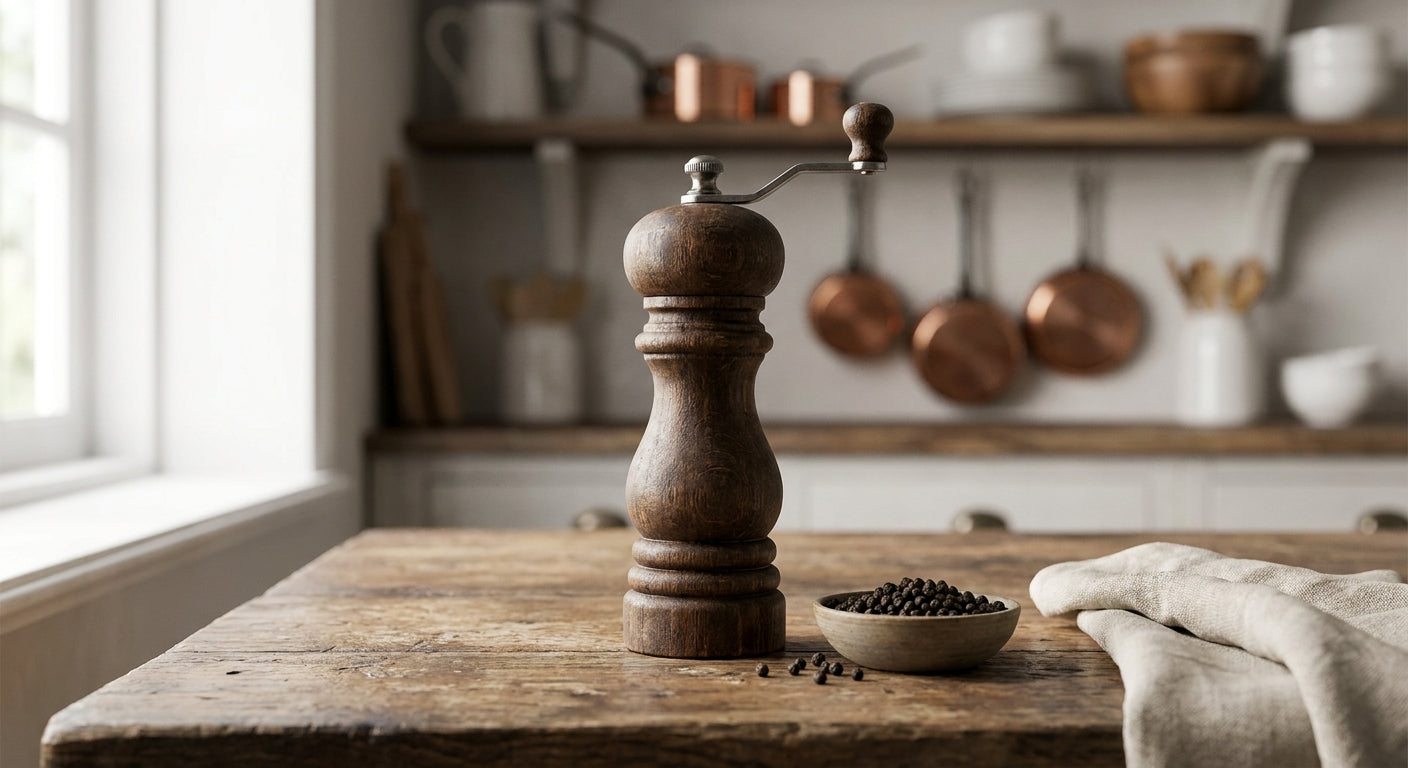


Persian blue salt is one of the hardest, driest salts on the market, and that combination makes it a great candidate for a mill but a rough ride for the wrong grinder. This guide walks through exactly how to load it, grind it, and keep your mill running in 2026 without cracking a mechanism designed for softer crystals.
- Blue salt is a hard, low-moisture rock salt that needs a mill rated for coarse, dense crystals — not a standard shaker grinder.
- Fill to two-thirds capacity, grind dry, and never mix blue salt with wet or oily blends in the same mill.
- A ceramic or hardened-steel mechanism, like PepperMate's traditional pepper mill design adapted for salt, handles blue salt's density without stripping gears.
- Clumping and jamming in 2026 usually trace back to humidity, not a defective mill — dry storage fixes most complaints.
Why this matters
Blue salt gets its color from trace mineral deposits, mostly sylvite, formed in ancient salt beds. That mineral content makes the crystal denser and harder than table salt or even most sea salt, which means a mill built for soft flaky salt will jam, skip, or wear out fast trying to process it.
Home cooks buy blue salt for the visual pop on a finishing plate and for a milder, slightly sweeter flavor than standard sea salt. But the whole appeal disappears if the mill can't produce a consistent fresh grind — you end up with oversized chunks in one turn and dust in the next. Getting the mechanism and technique right in 2026 is the difference between a $15 jar of blue salt that gets used weekly and one that sits half-full in a cabinet.
What you'll need
- A coarse-grind salt mill with a hardened-steel or ceramic mechanism (avoid plastic gears — blue salt will strip them within weeks)
- Persian blue salt, kept dry and sealed until you're ready to load it
- A small funnel or the mill's own hopper opening
- A dry cloth for wiping the mill body after loading
- A cool, low-humidity spot to store the mill between uses
If you don't already own a mill built for coarse rock salt, PepperMate's salt and pepper mill bundle is designed around a mechanism that adjusts from fine to coarse, which matters because blue salt performs best at a medium-coarse setting rather than a fine powder.
The steps
1. Check the crystal size before you buy
Blue salt sold in large rock form needs to be broken down before it goes anywhere near a mill hopper — chunks over half an inch will jam the feed mechanism immediately. Look for pre-cracked or coarse-cut blue salt, typically sold in the 2-4mm range, which is the sweet spot for most household mills. If you only have large rocks, break them with a mortar and pestle first; running whole rocks through a mill built for this purpose is the single most common cause of stripped gears.
Common mistake: buying decorative blue salt lamps or bath-salt-grade rock and assuming it's food-safe or millable — check the packaging for food-grade certification before it goes in any kitchen mill.
2. Fill the hopper to two-thirds capacity
Overfilling a salt mill compresses the crystals against the mechanism and increases resistance on every turn, which is what makes a mill feel like it's fighting you. Fill to about two-thirds of the chamber, leaving room for the crystals to move freely as the grind wheel turns. A too-full chamber is the second most common reason people think their mill is broken when it's just overloaded.
3. Set the grind to medium-coarse
Blue salt's flavor and visual appeal come through best at a medium-coarse setting — fine enough to season evenly, coarse enough to keep some crunch for finishing. Most adjustable mills, including the traditional pepper mill, use a top-dial or base-twist adjustment; turn it a quarter-turn at a time and test-grind a few crystals before committing to a full pass over food.
4. Grind with steady, even turns
Uneven, jerky cranking is what causes hard salts to skip inside the mechanism instead of shearing cleanly. Use full, slow rotations — about one turn per second — and let the mechanism do the work rather than forcing speed. Ten to twelve turns typically produces enough seasoning for a dinner-plate portion; you'll feel resistance ease up once the salt starts flowing evenly.
Expected outcome: a light, even dusting of blue-tinted crystals with no large chunks and no powder clumping at the base.
5. Wipe the mill dry after each use
Salt is hygroscopic — it pulls moisture from the air, and any residue left inside the mechanism after grinding will start absorbing humidity within hours. Wipe the exterior and the hopper opening with a dry cloth every time you finish grinding, and never rinse a wooden or non-waterproof mill body under a tap.
6. Store the mill somewhere dry, not near the stove
Steam from cooking is the fastest way to introduce moisture into a salt mill, and moisture is what turns loose blue salt crystals into a solid clump overnight. Keep the mill on a countertop away from the stove or sink, ideally in a spot with stable humidity year-round.
Common mistake: storing a salt mill directly next to a pepper mill that gets refilled with oil-cured peppercorns — cross-contamination of moisture and residue shortens the life of both mechanisms.


7. Rotate salts if you use more than one variety
If you keep a rotation of coarse salts — blue salt for finishing, a coarse salt blend for everyday cooking — use a dedicated mill for each rather than switching salts in and out of the same chamber. Residual crystals from a previous fill mix with the new load and mute the flavor and color effect blue salt is bought for in the first place.
Troubleshooting
- Mill feels stuck after a few turns: the chamber is overfilled or the crystals are too large — empty it, break down oversized pieces, and refill to two-thirds capacity.
- Salt comes out clumped instead of loose: moisture has gotten into the chamber, usually from steam or humid storage. Empty, dry the mechanism fully, and store away from the stove going forward.
- Grind is inconsistent, mixing dust and chunks: the adjustment dial is set too loose or too tight — reset it to a middle position and test on a small amount before grinding onto food.
- Mechanism feels gritty or grinds slower over time: mineral buildup inside a plastic-geared mill wears the teeth down permanently; a hardened-steel or ceramic mechanism resists this far longer.
- Top or base cracked from a drop: replacement parts, like a replacement top, let you keep the working mechanism instead of buying a whole new mill.
- No grind at all, just resistance: a single oversized rock has likely wedged sideways in the feed — empty the chamber completely rather than forcing the crank.
Tools and resources
- A coarse-grind salt mill with a metal or ceramic mechanism
- Food-grade Persian blue salt, pre-cracked to 2-4mm
- A dry storage spot away from steam and direct sunlight
- Replacement parts on hand for high-use mills
- A rotation of other coarse salts if you want variety without cross-contamination
What to do next
Once the mill and technique are dialed in, the next question most people ask is how much salt to actually use per dish — over-salting a delicate finishing salt like blue salt is easy to do when the mill grinds coarser than expected. Compare grind settings against a fresh pepper mill from PepperMate side by side to calibrate how many turns equal a pinch versus a full seasoning pass.
FAQ
Can you put blue salt in a regular salt mill?
You can, but only if the mill has a hardened-steel or ceramic mechanism — plastic-geared mills strip down quickly against blue salt's dense crystals. Check the mill's material spec before loading coarse rock salt into it.
What's the best mill for grinding blue salt in 2026?
An adjustable coarse-to-fine mill with a metal mechanism handles blue salt best, since it lets you dial in the medium-coarse setting the salt performs at. Wood or ceramic-bodied mills with steel grinding cores are the standard choice for hard rock salts this year.
Is blue salt better than pink Himalayan salt for a mill?
Neither is objectively better — blue salt is denser and milder in flavor, while pink Himalayan is slightly softer and easier on entry-level mills. Choose based on flavor preference and confirm your mill is rated for coarse salt either way.
How much does blue salt cost per pound?
Persian blue salt typically runs higher than standard sea salt because of its limited mining sources, often several times the price of common coarse sea salt per pound in 2026. Pricing varies by retailer and crystal grade, so check current listings before buying in bulk.
Why does my salt mill jam on blue salt but not table salt?
Table salt is fine and uniform, while blue salt is coarse and irregular in shape, which puts more mechanical stress on the grind mechanism. A mill without a hardened mechanism will jam or skip on the harder, larger crystals long before it struggles with fine table salt.
Does blue salt go bad or lose color over time?
Blue salt doesn't spoil, but its color can fade slightly if stored in direct sunlight or high humidity for extended periods. Keep it sealed and away from light to preserve both the color and the dry, free-flowing texture a mill needs.
Can you use a pepper mill for blue salt instead of a dedicated salt mill?
Most pepper mills are built for the softer texture of dried peppercorns and aren't rated for salt's corrosive, moisture-drawing properties, which can damage the mechanism over time. Use a mill specifically designed or rated for salt, and keep pepper and salt mills separate.
What grind size is best for finishing a dish with blue salt?
Medium-coarse is the standard finishing grind for blue salt, fine enough to season evenly but coarse enough to retain visible crystal and crunch. Test a few turns on a plate before committing to a full pass over the dish.
One last thing
Blue salt's color comes from sylvite deposits, the same mineral family that gives some salts a pink or grey tint depending on trace composition — meaning the mill mechanism matters more than the salt's origin story. A well-built grinder from 2026's coarse-salt-friendly designs will outlast several jars of blue salt; a cheap plastic one won't survive the first pound.